





































Number of beneficial insects and m²


Australian ladybirds against mealybugs, scale insects & aphids
-
100% natural help against aphids & more
-
From German breeding – fast delivery
-
No chemicals – no residues
-
Discreet, effective & biologically sustainable
-
Safe for children & pets
Number of beneficial insects and m²
In stock - arrives in 2-4 business days



Was unsere Kund*innen sagen
-
Wirksamkeit
kaum Wirkung teilweise wirksam sehr wirksam -
Anwendung
kompliziert etwas Aufwand kinderleicht -
Lieferqualität
schlechter Zustand ok top Qualität
Lieferoption wählen & clever sparen:


Choose options
-
100% natural help against aphids & more
-
From German breeding – fast delivery
-
No chemicals – no residues
-
Discreet, effective & biologically sustainable
-
Safe for children & pets
Number of beneficial insects and m²
In stock - arrives in 2-4 business days
Lieferoption wählen & clever sparen:
-
100% natural help against aphids & more
-
From German breeding – fast delivery
-
No chemicals – no residues
-
Discreet, effective & biologically sustainable
-
Safe for children & pets
Number of beneficial insects and m²
In stock - arrives in 2-4 business days
Lieferoption wählen & clever sparen:
GREEN GUARDIA Cryptolaemus – Australian ladybirds against mealybugs, scale insects & aphids
Mealybugs, scale insects and aphids can significantly weaken plants and often leave behind sticky honeydew secretions as well as typical white deposits on leaves, shoots, and stems. The Australian ladybird (Cryptolaemus montrouzieri) is a natural beneficial insect that specifically tracks down these pests and uses them as a food source.
Both the larvae and the adult beetles feed primarily on mealybugs and scale insects. Aphids can also occasionally serve as an additional food source. This makes Cryptolaemus ideal for naturally supporting the biological balance of your plants – without the need for any chemical agents.
Suitable areas of application
- Houseplants: Especially suitable for infestations of mealybugs, scale insects, or aphids.
- Conservatories & greenhouses: Ideal conditions for using these beneficial ladybirds.
- Ornamental plants & potted plants: Supports the natural regulation of pest populations.
- Orchids & sensitive plants: A gentle method without chemical residues.
- Indoors & protected areas: Particularly suitable for constant temperatures.
How to use
- Open the tube: Carefully open the shipping tube directly at the site of application.
- Release the beneficials: Carefully place the beetles near the infested plant or position the open tube in the immediate vicinity.
- Let nature take its course: The beneficial insects will actively search for mealybugs, scale insects, and other suitable food sources and will begin their search independently after release.
Important notes
- Temperature: Optimal at temperatures between 20 °C and 30 °C.
- No chemicals: Do not use chemical pesticides before or after release.
- Use immediately: Release the beneficial insects as soon as possible after receipt.
- Delivered in a tube: The ladybirds are delivered securely in a shipping tube.
- In case of severe infestation: An additional release may be useful.
🐞 Tip: Release the ladybirds as close as possible to the infested parts of the plant – this allows them to find mealybugs and scale insects particularly quickly.
Wie viele Larven brauche ich?
Wenn du Australische Marienkäferlarven kaufen willst, richtet sich die Menge nach der Fläche: Ein Röhrchen mit 25 Larven reicht bei leichtem bis mittlerem Befall für etwa 10 m². Wähle die Menge entsprechend deiner Pflanzenfläche.
Anwendung & Tipps: So nutzt du Australische Marienkäferlarven richtig
- Röhrchen öffnen: Das Versandröhrchen vorsichtig direkt am Einsatzort öffnen, nicht vorher.
- Larven ausbringen: Die Larven möglichst direkt an den befallenen Pflanzenteilen, in den Blattachseln oder nahe der Wolllausnester aussetzen.
- Wirken lassen: Die Larven suchen selbstständig nach Wollläusen und Schmierläusen und beginnen unmittelbar nach dem Aussetzen mit der Nahrungssuche.
- Temperatur: Optimal zwischen 20 und 30 °C. Deshalb vor allem für Innenräume, Wintergärten und Gewächshäuser geeignet.
- Direkt einsetzen: Die Larven nach Erhalt möglichst zeitnah ausbringen.
- Keine Chemie: Mindestens sechs Wochen vor und während des Einsatzes auf chemische Pflanzenschutzmittel verzichten.
- Bei starkem Befall: Eine zusätzliche Ausbringung nach einigen Wochen unterstützt die Ansiedlung.
- Vorbeugen: Pflanzen regelmäßig kontrollieren, besonders Blattunterseiten, Stängel und Triebspitzen. Bei den ersten Anzeichen früh Nützlinge einsetzen – und die Pflanzen stärken, denn gesunde Pflanzen sind widerstandsfähiger.
Geeignete Einsatzbereiche
- Zimmerpflanzen: Ideal bei Befall mit Wollläusen und Schmierläusen.
- Wintergärten & Gewächshäuser: Optimale Bedingungen für die Entwicklung der Larven.
- Zierpflanzen & Kübelpflanzen: Unterstützt die natürliche Regulierung von Wolllauspopulationen.
- Orchideen & empfindliche Pflanzen: Schonende Anwendung ohne chemische Rückstände.
- Innenräume & geschützte Bereiche: Besonders geeignet bei konstanten Temperaturen.
🐞 Tipp: Setze die Larven möglichst direkt an befallenen Pflanzenteilen aus. Dort finden sie Wollläuse besonders schnell und können unmittelbar mit ihrer natürlichen Nahrungssuche beginnen.
Blattläuse, Schmierläuse & Wollläuse natürlich regulieren – mit GREEN GUARDIA Cryptolaemus (Australischer Marienkäfer)
Blattläuse, Schmierläuse und Wollläuse zählen zu den häufigsten Pflanzenschädlingen an Zimmerpflanzen, Zierpflanzen sowie in Wintergärten und Gewächshäusern. Sie saugen Pflanzensäfte, schwächen das Wachstum und hinterlassen häufig klebrige Honigtau-Ausscheidungen auf Blättern und Stängeln.
Mit GREEN GUARDIA Cryptolaemus setzt du auf eine natürliche und chemiefreie Lösung. Der Australische Marienkäfer ernährt sich gezielt von Schmierläusen, Wollläusen und auch Blattläusen und hilft dabei, den Schädlingsbefall auf natürliche Weise zu regulieren.
Was macht diese Schädlinge so problematisch?
- Blattläuse: Vermehren sich sehr schnell und schwächen Pflanzen durch das Saugen von Pflanzensäften.
- Schmierläuse: Bilden weiße, watteartige Beläge an Stängeln und Blättern und verstecken sich oft in Blattachseln.
- Wollläuse: Hinterlassen klebrigen Honigtau, der häufig zu Rußtaupilzen auf Pflanzen führt.
So beugst du einem Befall vor
- Pflanzen regelmäßig kontrollieren: Besonders Blattunterseiten, Stängel und Triebspitzen prüfen.
- Frühzeitig handeln: Bei ersten Anzeichen von Befall schnell Nützlinge einsetzen.
- Pflanzen stärken: Gesunde Pflanzen sind widerstandsfähiger gegenüber Schädlingen.
- Natürliche Nützlinge einsetzen: Cryptolaemus-Marienkäfer helfen, Schädlingspopulationen auf natürliche Weise zu regulieren.
🐞 Tipp: Cryptolaemus arbeitet am effektivsten bei Temperaturen zwischen 20 °C und 30 °C. Bei stärkerem Befall kann eine zweite Ausbringung nach einigen Wochen sinnvoll sein.

GREEN GUARDIA vs. Other providers
What sets us apart from the rest

|

|

Produkte für Haus, Garten & tiernahe Bereiche |

Unklare Produktinfos |

Nützlinge aus deutscher Zucht |
Unklare Herkunftsangaben |

Praxisnah entwickelt |
Komplizierte Auswahl |

Klare Anwendungshinweise |
Wenig Anwendungshinweise |

Frisch abgefüllt bzw. sorgfältig verpackt |
Längere Lager- oder Lieferzeiten möglich |

German breeding
Beneficial insects from controlled German breeding – quality you can rely on

Expert advice
Application tips and support from our experts – targeted and effective.

Fast help
Our beneficial insects are ready for immediate use and help target acute infestations in your home or garden.

Natural & safe
Safe for everyday life – use is absolutely risk-free for children, pets & plants.
We let our customers speak for us.

Natural pest control
At GREEN GUARDIA you will find the right natural solution for every pest problem – without any chemicals.
Whether parasitic wasps against moths, predatory mites against spider mites, or nematodes against fungus gnats and slugs – our beneficial insects provide reliable help in the home, garden, or greenhouse.
As a specialist in biological pest control, we stand for quality, innovation, and sustainable results – in harmony with nature, people, and animals.

Expert advice – Personal & practical
Our specialist consultants support you with targeted application tips and many years of experience in natural pest control. Whether you have questions about application, combining different beneficial insects, or selecting the right product – we are here to help you quickly and competently.
FAQ Australian ladybug
Do you have questions about our products, their application, or shipping? Here you will find the most important answers at a glance. If anything remains unclear, please feel free to contact us!
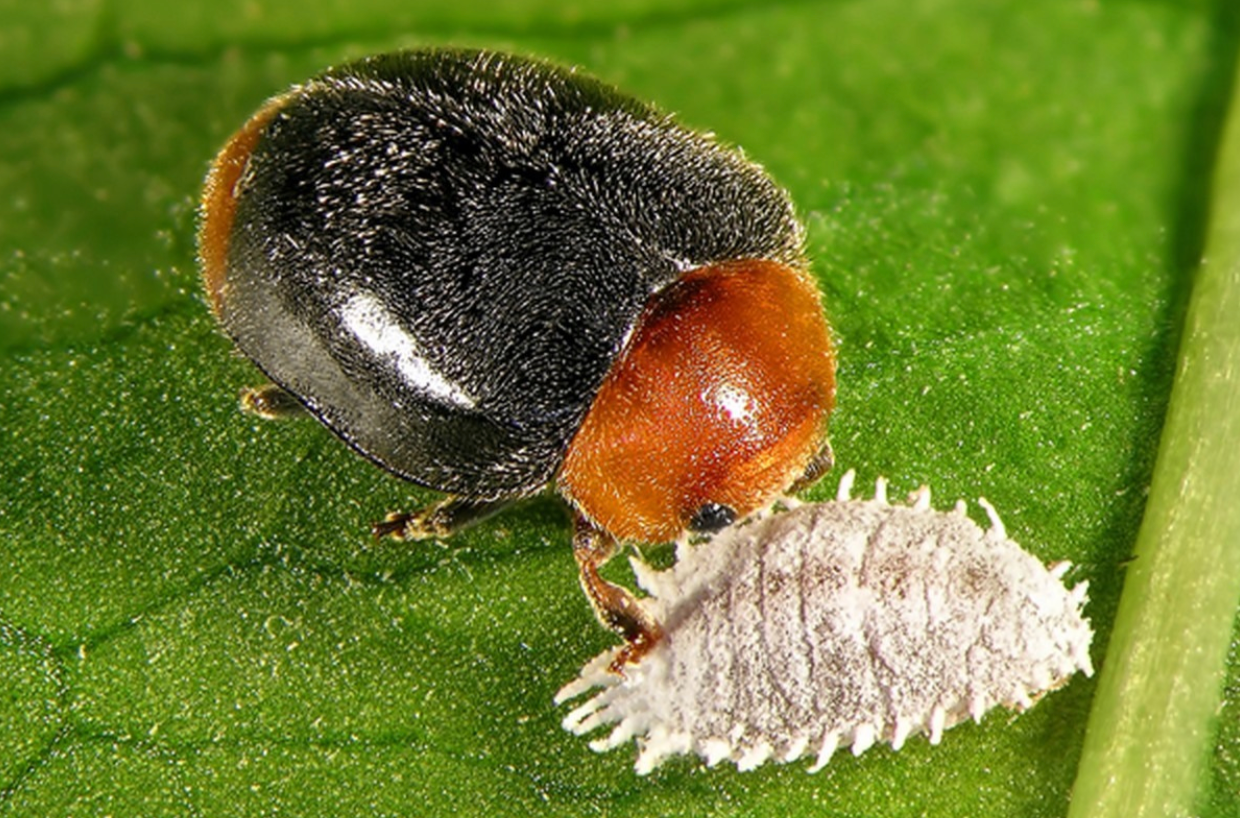
Cryptolaemus montrouzieri, also known as the Australian ladybug, is a natural beneficial insect for controlling mealybugs, woolly aphids, and aphids. Both the adult beetles and their larvae feed on these pests, helping to reduce the infestation in a natural way.
A tube with 10 adult Cryptolaemus ladybugs or 25 Cryptolaemus larvae is suitable for a plant area of up to 10 m², depending on the severity of the infestation. In cases of heavier infestation or high pest density, an additional application may be advisable.
Cryptolaemus feeds mainly on mealybugs and woolly aphids. Additionally, it also eats aphids, making it versatile for use against various types of lice.
Under good conditions, the beetles can reproduce. The larvae that hatch from the eggs also consume large quantities of mealybugs and woolly aphids.
Use is particularly suitable for houseplants, conservatories, greenhouses, and protected outdoor areas.
The beneficial insects are delivered alive and securely in a ventilated shipping tube. You can choose between tubes with 10 adult Cryptolaemus ladybugs or 25 Cryptolaemus larvae. After release, the beneficial insects begin to search for suitable food sources on their own and are suitable for plant areas of up to 10 m², depending on the severity of the infestation.
The beneficial insects should be released as soon as possible after receipt so they can quickly start searching for pests.
If necessary, the beetles can be stored in a cool, shady place for 1–2 days. Ideally, however, they should be used quickly.
Yes, they are shipped in special tubes that provide sufficient air and protection during transit. We also ship the ladybugs via Express Registered Mail.
The animals are usually quieter during transit but will quickly become active again after release.
Open the box carefully right by the infested plants and release the beetles as close as possible to the affected plant parts.
Cryptolaemus works most effectively at temperatures between 20 °C and 30 °C.
The beetles stay where they find food. If there are enough pests, they usually stay in the plant area for a longer period of time.
Yes, they can be well combined with other biological beneficial insects. It is important, however, not to use chemical plant protection products.
No, it is best to release them directly on the infested plants so they can find the pests quickly.
Yes, the ladybugs are completely harmless to humans, pets, and plants.
The beetles often hide between leaves or in leaf axils, where the mealybugs are located.
The ladybugs start searching for food immediately after release. A visible reduction in infestation can occur after about 2–3 weeks, depending on the severity.
Yes, adult Cryptolaemus ladybugs can fly. If there is sufficient food supply, however, they predominantly stay in the area of the infested plants. The larvae are not capable of flight and remain directly on the plant, where they actively search for suitable food sources.
In case of very heavy infestation, an additional release after a few weeks may be advisable.


