






















































Number of beneficial insects and m²


Braconid wasps for pantry moths
-
100% natural help against pantry moths
-
From German breeding – fast delivery
-
Completely chemical-free – no residue
-
Discreet, effective & biologically sustainable
-
Safe for children & pets
Number of beneficial insects and m²
In stock - arrives in 2-4 business days


Was unsere Kund*innen sagen
-
Wirksamkeit
nicht wirksam sehr wirksam -
Anwendung
kompliziert kinderleicht -
Verträglichkeit
bedenklich sehr sicher
Lieferoption wählen & clever sparen:


Choose options
-
100% natural help against pantry moths
-
From German breeding – fast delivery
-
Completely chemical-free – no residue
-
Discreet, effective & biologically sustainable
-
Safe for children & pets
Number of beneficial insects and m²
In stock - arrives in 2-4 business days
Lieferoption wählen & clever sparen:
-
100% natural help against pantry moths
-
From German breeding – fast delivery
-
Completely chemical-free – no residue
-
Discreet, effective & biologically sustainable
-
Safe for children & pets
Number of beneficial insects and m²
In stock - arrives in 2-4 business days
Lieferoption wählen & clever sparen:
Braconid wasps for pantry moths – natural pest control
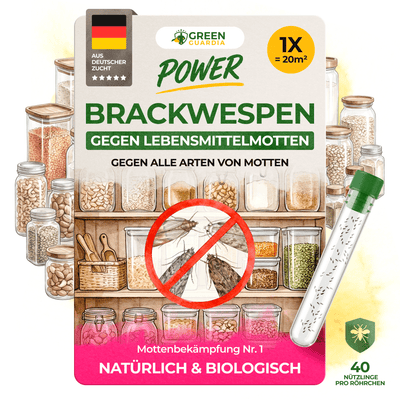
Braconid wasps for pantry moths are 2–3 mm small beneficial insects of the species Habrobracon hebetor, which actively search for moth larvae in the infested area and parasitize them, so that Indian meal moths, flour moths, and warehouse moths can no longer reproduce. They are a biological alternative to chemical agents and are harmless to humans, pets, and food.
First the moths, then the webbing in the cereal
A small grey-brown moth on the kitchen cupboard, two days later there are three. Looking into the cereal box, you see fine threads between the flakes, and clumps sticking together in the flour. The moths themselves are only the visible part. The actual damage is caused by their larvae, which eat their way through flour, nuts, dried fruit, or pet food, contaminating everything with webbing and droppings. If you only hunt the moths, you are letting the offspring continue to feast.
Combatting pantry moths where they hide
Indian meal moths love nuts, dried fruit, and cereal, flour moths reproduce particularly quickly in flour and baking ingredients, while warehouse moths go after almost any dry pantry item. Their larvae do not stay nicely inside the package. They crawl into cracks, shelf corners, and storage containers, and an infestation often spreads unnoticed throughout the entire cupboard, reaching as far as the larder or pantry. Because this involves food, insecticides have no place in these rooms.
The larva hunters from the tube
GREEN GUARDIA braconid wasps (Habrobracon hebetor) are natural adversaries of moth larvae. You open the tube in the infested room, the 2–3 mm small beneficial insects leave it on their own and search for the larvae in supplies, packaging, and cracks. Once there, they parasitize the larvae so that no new generation of moths can develop. Once the work is done, the braconid wasps disappear on their own. They do not sting, leave no residues, and are harmless to humans, pets, and food.
Order braconid wasps for pantry moths online
A tube with around 40 braconid wasps is sufficient for about one room or 20 m²; for larger storage areas, order up to five tubes for around 100 m². The beneficial insects are bred in Germany and travel as live goods; specific shipping instructions are provided for hot and cold days. They are particularly thorough when used as a team with our trichogramma wasps for pantry moths. The braconid wasps take care of the larvae already feeding in the supplies, while the trichogramma wasps catch the next generation in the egg stage. Since our range is organized by target pest, you will find both right next to each other.
When are braconid wasps the right choice?
Choose braconid wasps if you find larvae, webbing, or clumped food in the kitchen, larder, or pantry and want to stop the infestation biologically instead of using chemicals. They are the right choice if Indian meal moths, flour moths, or warehouse moths are involved and you want to tackle the problem directly at the feeding larvae stage. They work best at room temperatures between approximately 20 and 30 °C; in the case of a severe infestation, follow up with a second application after two to three weeks.
When are braconid wasps not the right remedy?
Braconid wasps target the larvae, not the eggs and not the adult moths. Anyone looking to combat pantry moths and break the entire cycle should combine them with trichogramma wasps for pantry moths or additionally hang up a pantry moth trap. For clothes moths in the wardrobe, our trichogramma wasps for clothes moths are the better choice. Heavily infested food can no longer be saved even by beneficial insects; that belongs in the trash.
🌿 Conclusion: GREEN GUARDIA braconid wasps are a biological, residue-free solution against moth larvae in the kitchen and pantry. Easy to apply and harmless to humans, pets, and food.
Put an end to the freeloaders in your cereal. Buy braconid wasps for pantry moths now!
Anwendung der GREEN GUARDIA Brackwespen
Die Anwendung ist einfach und effektiv – ideal zur biologischen Bekämpfung von Lebensmittelmotten in Küche, Vorratsraum oder Speisekammer.
Anwendung & Tipps: So nutzt du Brackwespen richtig
- Vorbereitung: Befallsorte identifizieren – z. B. Vorratsschränke, Speisekammern, Küchenregale oder Lagerräume mit trockenen Lebensmitteln.
- Ausbringung: Das Röhrchen im befallenen Raum öffnen und aufrecht oder leicht geöffnet in der Nähe der Befallsstelle platzieren. Die Brackwespen verlassen das Röhrchen selbstständig.
- Wirkungsbereich: Ein Röhrchen mit ca. 40 Brackwespen reicht für etwa einen Raum bzw. ca. 20 m².
- Temperatur: Optimal zwischen etwa 20–30 °C
- Lebensmittel prüfen: Stark befallene Produkte entsorgen
- Keine Insektizide: Während der Anwendung keine chemischen Mittel verwenden
Geeignete Einsatzbereiche
- Küche & Vorratsräume: Bei Befall von Dörrobstmotten, Mehlmotten oder Speichermotten
- Speisekammern: Zur biologischen Kontrolle in Lebensmittelvorräten
- Wohnbereiche: Wenn sich Motten aus der Küche im Wohnraum ausbreiten
- Lagerräume: Für größere Vorrats- oder Lagerbereiche
- Gewerbe: Ideal für Bäckereien, Lebensmittelbetriebe, Mühlen oder Lager
🛡️ Tipp: Bei stärkerem Befall kann eine zweite Anwendung nach 2–3 Wochen sinnvoll sein, um auch später schlüpfende Mottenlarven zu erfassen.
Lebensmittelmotten natürlich bekämpfen – mit GREEN GUARDIA Brackwespen
Lebensmittelmotten wie Dörrobstmotten, Mehlmotten oder Speichermotten gehören zu den häufigsten Vorratsschädlingen im Haushalt. Sie legen ihre Eier in trockenen Lebensmitteln wie Mehl, Reis, Nüssen, Gewürzen oder Tierfutter ab. Die schlüpfenden Larven verunreinigen die Vorräte mit Gespinsten und Kot und können sich schnell im gesamten Vorratsschrank ausbreiten.
Mit GREEN GUARDIA Brackwespen setzt du auf eine 100 % natürliche und rückstandsfreie Lösung zur Bekämpfung von Lebensmittelmotten – ganz ohne Chemie und unbedenklich für Mensch, Haustiere und Lebensmittel.
Warum sind Lebensmittelmotten so problematisch?
- Dörrobstmotten: Befallen Nüsse, Trockenfrüchte, Müsli und Getreideprodukte.
- Mehlmotten: Vermehren sich besonders schnell in Mehl, Backzutaten und Getreide.
- Speichermotten: Befallen zahlreiche trockene Lebensmittel und Vorräte.
- Die Larven verstecken sich in Verpackungen, Ritzen und Vorratsbehältern.
- Ein Befall breitet sich oft unbemerkt auf mehrere Lebensmittel aus.
So schützt du deine Vorräte natürlich
- Lebensmittel kontrollieren: Befallene Produkte sofort entsorgen.
- Vorratsschränke reinigen: Regale, Ritzen und Ecken gründlich säubern.
- Luftdichte Behälter nutzen: Lebensmittel möglichst dicht verschließen.
- Nützlinge einsetzen: Brackwespen suchen gezielt nach Mottenlarven und stoppen die weitere Vermehrung der Motten.
🛡️ Tipp: Bei stärkerem Befall kann eine zweite Anwendung nach 2–3 Wochen sinnvoll sein, um auch später schlüpfende Mottenlarven zuverlässig zu erfassen.

GREEN GUARDIA vs. other providers
What sets us apart from the rest

|

|

Produkte für Haus, Garten & tiernahe Bereiche |

Unklare Produktinfos |

Nützlinge aus deutscher Zucht |
Unklare Herkunftsangaben |

Praxisnah entwickelt |
Komplizierte Auswahl |

Klare Anwendungshinweise |
Wenig Anwendungshinweise |

Frisch abgefüllt bzw. sorgfältig verpackt |
Längere Lager- oder Lieferzeiten möglich |

German breeding
Beneficial insects from controlled German breeding – quality you can rely on

Expert advice
Application tips and support from our experts – targeted and effective.

Fast help
Our beneficial insects are ready for immediate use and help specifically with acute infestations in the house or garden.

Natural & safe
Harmless in everyday life – usage is absolutely risk-free for children, pets & plants.


We let our customers speak for us.

Natural pest control
At GREEN GUARDIA you will find the right natural solution for every pest problem – without any chemicals.
Whether trichogramma wasps against moths, predatory mites against spider mites, or nematodes against fungus gnats and slugs – our beneficial insects provide reliable help in the house, garden, or greenhouse.
As a specialist in biological pest control, we stand for quality, innovation, and sustainable effectiveness – in harmony with nature, people, and animals.

Expert advice – Personal & practical
Our expert advisors support you with targeted application tips and many years of experience in natural pest control. Whether you have questions about application, combining different beneficial insects, or selecting the right product – we are here to help you quickly and competently.
FAQ Braconid wasps
Do you have questions about our products, their application, or shipping? Here you will find the most important answers at a glance. If something remains unclear, please feel free to contact us!

Braconid wasps are tiny, naturally occurring beneficial insects frequently used as biological support against stored-product pests. They are only a few millimeters in size and barely visible to humans.
Braconid wasps are frequently used for problems with typical stored-product pests like grain weevils, rice weevils, or drugstore beetles, which can develop in dry food products.
No. Braconid wasps are harmless to humans and pets. They do not sting and are interested exclusively in suitable hosts.
Yes, braconid wasps are frequently used in kitchens, pantry cupboards, larders, or storage rooms where dry food is kept.
Braconid wasps are only about 2–3 mm long and therefore very inconspicuous. Many people hardly notice them in everyday life.
The braconid wasps are delivered in a tube containing approx. 40 beneficial insects. Shipping is via registered mail (drop-in), so the parcel can be delivered directly into your mailbox.
Each delivery contains approximately 40 braconid wasps inside a small shipping tube.
Shipping usually takes place quickly via post. The registered drop-in delivery ensures the shipment lands directly in your mailbox.
After receiving them, the braconid wasps should be released at the site of application as soon as possible so they can become active.
No, refrigeration is usually not necessary. The tubes can be stored at normal room temperature until use.
Carefully open the tube near the affected storage areas, for example in kitchen cupboards, pantries, or on pantry shelves.
The beneficial insects should be placed as close as possible to the suspected infestation sites, such as near food containers or shelf boards.
Yes, braconid wasps are very active and move independently through the storage area in search of suitable locations.
The required quantity depends on the size of the area and the situation. Multiple applications at intervals of a few weeks are often recommended.
We recommend 1 tube per room or per 20m².
Yes, for larger areas or multiple cupboards, several tubes can be distributed simultaneously.
Please do not do so directly near the tube – vacuum cleaners or chemical cleaning agents could impair their effectiveness.
Braconid wasps live for only a limited time. Their lifespan depends heavily on environmental conditions and available food sources.
Yes. Once there are no longer any suitable conditions, the braconid wasps will disappear on their own.
No. Without suitable hosts, braconid wasps cannot reproduce permanently.
It is advisable to check the storage area regularly and dispose of heavily infested food.
Many users also utilize braconid wasps preventively in storage rooms or pantries to reduce the risk of a larger infestation.


