





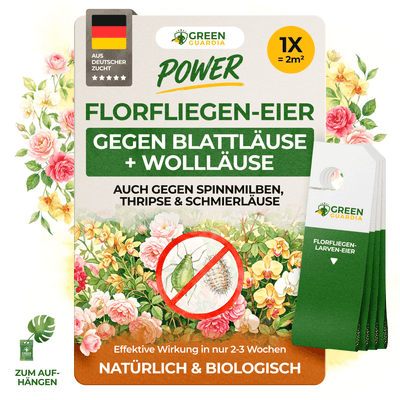


























Identifying whiteflies and controlling them with beneficial insects
Small white insects fly up when you touch your plants and the leaves are becoming sticky? This may indicate whiteflies. Our Encarsia parasitic wasps and Eretmocerus parasitic wasps target susceptible larval stages directly on the leaves. Find out here which beneficial insect suits your infestation and what to keep in mind regarding nematodes.
Identifying whiteflies: Typical signs
Despite their name, whiteflies are not true flies, but rather whiteflies (Aleyrodidae). Adults have powdery white wings and are frequently found on the undersides of leaves.
- Small white bugs fly up when disturbed.
- Flat, sluggish larvae sit under the leaves.
- Leaves and surfaces underneath are sticky.
- The plant grows more weakly in cases of heavier infestations.
What damage do whiteflies cause?
These pests feed on plant sap and excrete honeydew. Dark sooty mold fungi can settle on this sticky coating. Heavy infestations can impair growth and plant quality.
Which plants are frequently affected?
Whiteflies appear on various vegetables and ornamental plants, for example on tomatoes, cucumbers and plants in conservatory settings. The exact type of pest is important for selecting the correct beneficial insects.
Where do whiteflies develop?
Eggs and immature stages are located on the leaves. After the first mobile larval stage, subsequent stages remain mostly stationary. Whiteflies do not have a regular developmental phase in the potting soil.
Therefore, beneficial insects must reach the pests directly on the plant. New plants can introduce an infestation; favorable conditions then enable rapid reproduction.
Encarsia or Eretmocerus: What should you order?
| Product | Particularly suitable for | Why? |
|---|---|---|
| Encarsia formosa | For greenhouse whiteflies under suitable conditions. | Parasitizes larvae directly on the underside of the leaf. |
| Eretmocerus eremicus | For sweetpotato whiteflies or warm conditions. | Suitable against Bemisia tabaci and Trialeurodes vaporariorum; comparatively heat-tolerant. |
| Nematodes | Only after clarifying a suitable foliar treatment with the specific product. | A purely soil-based application does not reach the stages on the leaves. |
You don't need to order all products. Choose first based on pest type, temperature, and location. If the species is unclear, sharp photos of the insects and leaf undersides can help with consulting.
Our Encarsia parasitic wasps: Why they are suitable against whiteflies
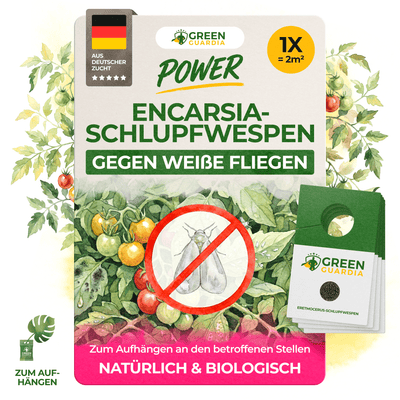
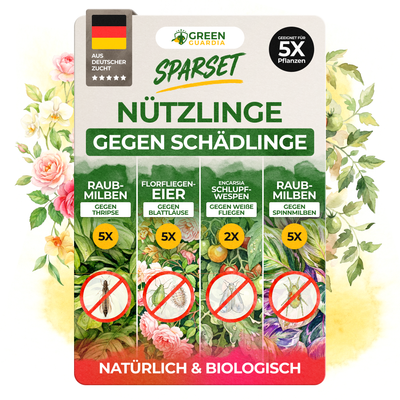
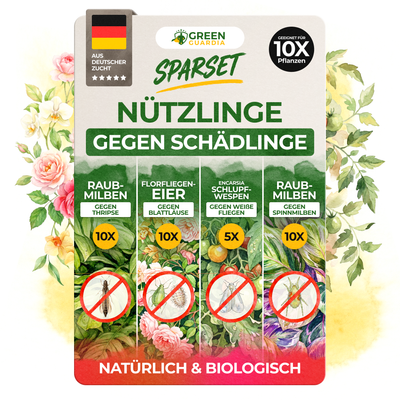
Our Encarsia parasitic wasps belong to the species Encarsia formosa. They are a proven choice against the greenhouse whitefly Trialeurodes vaporariorum.
Green Guardia Encarsia Parasitic Wasps
A suitable solution for appropriate plant populations in greenhouses, conservatories, or indoor spaces. Introduce the beneficial insects as early as possible, before large colonies form.
- Why suitable: Females seek out larvae on the leaves.
- Mode of action: Egg laying in suitable host larvae and additional host-feeding.
- Advantage: targeted approach to the next generation of pests.
- Keep in mind: Temperature, light, and previous plant protection treatments influence their use.
How do you recognize parasitism?
In the case of greenhouse whiteflies, parasitized stages turn dark to black. Do not prematurely remove such leaves: New parasitic wasps may already be developing inside them.
Our Eretmocerus parasitic wasps: Why they are interesting in warm conditions
Our Eretmocerus parasitic wasps belong to the species Eretmocerus eremicus. They are used against the greenhouse whitefly and the sweetpotato whitefly Bemisia tabaci.
Green Guardia Eretmocerus Parasitic Wasps
Particularly interesting for warm greenhouse and indoor conditions, when the pest species and application conditions match.
- Why suitable: Combat suitable larval stages of both major greenhouse species.
- Mode of action: Egg deposition under the host larva; the hatching beneficial larva then penetrates inside.
- Advantage: cope comparatively well with higher temperatures.
- Keep in mind: Not an automatic substitute for identifying the whitefly species.
Can you combine Encarsia and Eretmocerus?
A coordinated combination can make sense for suitable plant stands. Whether you need both depends on the pest species, climate, and infestation development. Do not buy them together simply because both are offered against whiteflies.
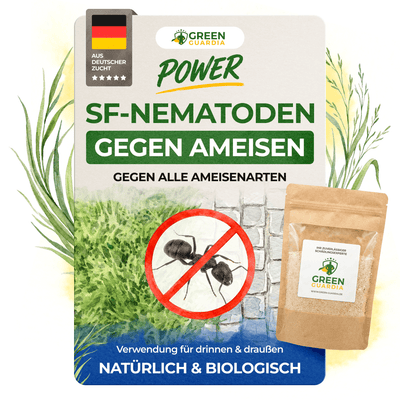
Nematodes against whiteflies: Why application is crucial
Suitable nematode formulations can be used for a foliar treatment against certain whiteflies. In this process, the beneficial insects must actually reach the pests.
Our linked product page currently describes a soil application. Since whiteflies go through their immature stages on the leaves, we do not recommend this watering application as a solution against whiteflies.
Green Guardia Nematodes against whiteflies
Check before ordering whether a suitable foliar treatment against the existing species is confirmed for the specifically delivered product. Do not independently change a watering instruction into a spray application.
View product and clarify applicationApplying parasitic wasps correctly
- Assess infestation: Check species, leaf undersides, and existing stages.
- Choose the right product: Incorporate temperature and location into your selection.
- Plan quantity: Consider current product instructions, plant density, and severity of infestation.
- Release cards: Distribute among plants according to delivery instructions and protect from direct sunlight.
- Protect beneficial insects: Do not spray cards and check compatibility of other products.
- Monitor development: Examine leaf undersides regularly and adhere to recommended repetitions.
Why don't the white insects disappear immediately?
Parasitic wasps primarily target the larvae. Adults already present may initially remain visible. Therefore, also evaluate new larvae, parasitism, and long-term development.
What else can you do?
- Check new plants before bringing them in.
- Keep infested plants separated if possible.
- Targeted removal of heavily infested leaves before releasing beneficial insects.
- Protect parasitized stages after release.
- Use yellow sticky traps only as a supplementary monitoring tool.
Frequently asked questions about whiteflies
Why are parasitic wasps suitable against whiteflies?
They seek out suitable larvae on the leaves and parasitize them. This targets the next generation directly.
When should I order Encarsia?
Particularly for greenhouse whiteflies and suitable conditions in protected plant populations. Start as early as possible in the infestation.
When is Eretmocerus particularly useful?
For sweetpotato whiteflies as well as in warm conditions. Eretmocerus eremicus can also be used against greenhouse whiteflies.
Does a nematode watering treatment work against whiteflies?
A purely soil-based application does not reach their leaf stages. For nematode use, a suitable foliar treatment of the specific product must be confirmed.
Can I spray any nematode product onto the leaves?
No. Formulation, application, and target pest must match. Do not independently apply a watering instruction as a foliar treatment.
Do I have to order all three products?
No. Choose based on species, location, and temperature. Encarsia or Eretmocerus are the directly matching options; combinations should be coordinated.
Does the recommendation also apply to whiteflies on cabbage outdoors?
Not automatically. A different whitefly species may be present there. Have the species and suitability clarified before purchasing.
How do I recognize treatment success?
By the development of the larval population, parasitized stages, and fewer new infestations. Individual flying insects alone do not allow for a full assessment.