










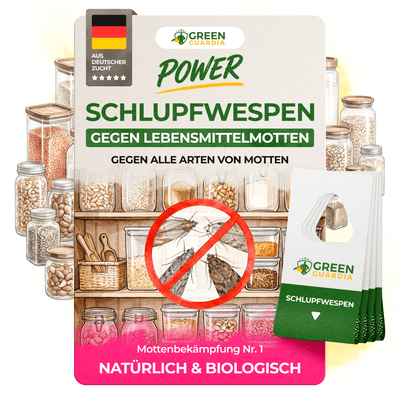






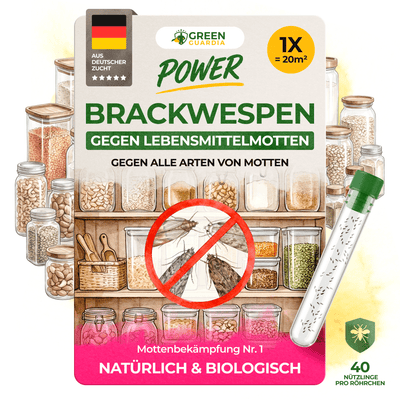




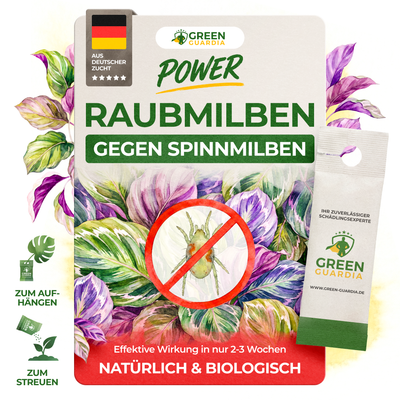





































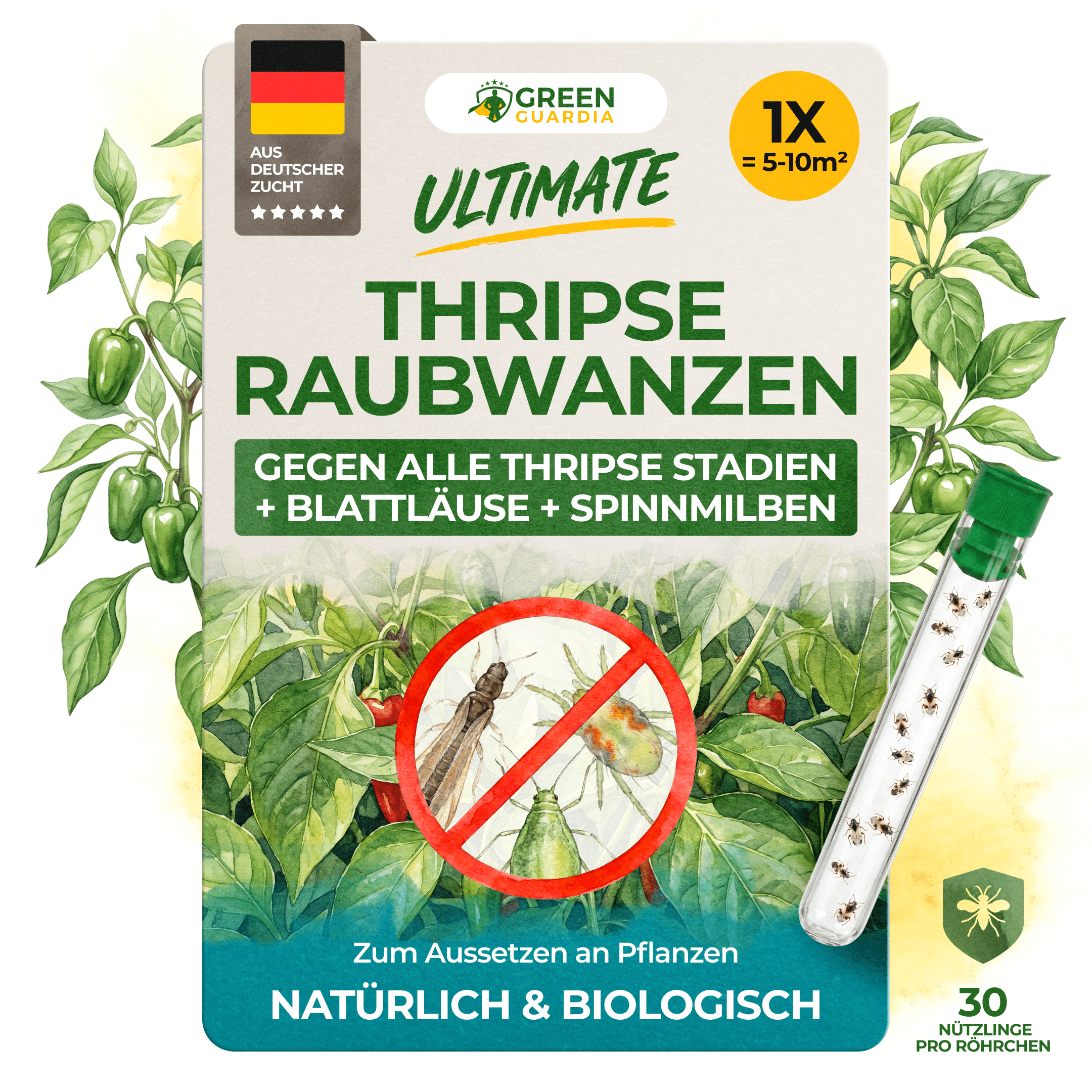
Identifying thrips and biologically controlling them with beneficial insects
Silvery leaf patches, black droppings, and deformed new growth can indicate thrips. These small plant pests hide on leaves, in flowers, and on young shoots. Here you will learn how to identify a thrips infestation, what causes play a role, and which measures help. In the solutions section, we introduce our Cucumeris and Swirskii predatory mites, Orius pirate bugs, and nematodes.
What are thrips?
Thrips are also known as fringed wings. They are very small, slender insects. Plant-damaging species pierce cells and consume their contents. What remains are light, silvery, or scarred-looking spots.
5Depending on the species, adult animals possess narrow, fringed wings. The young larvae are often lighter and easily overlooked without magnification. Color and size alone are not enough for reliable species identification.
Identifying thrips: typical signs on plants
- Silvery, streaky, or scratched-looking leaf surfaces.
- Small black droppings on affected plant parts.
- Deformed or curled young leaves.
- Spots on petals and damaged buds.
- Tiny elongated animals or light larvae on the undersides of leaves, in flowers, and in new growth.
In severe infestations, leaf surfaces can dry out and plant growth can become stunted. Certain thrips species can also transmit plant viruses. The severity of the damage depends on the species, infestation level, and the affected plant.
How to check if you suspect an infestation
Check several leaves with a magnifying glass. Inspect the undersides of leaves, flowers, and tightly folded new growth in particular. Gently tap suspicious plant parts over a white sheet of paper: Mobile insects are often easier to spot on it.
The tapping test alone does not confirm a specific thrips species. Check multiple characteristics together. Silvery damage can also be caused by other factors.
Thrips or spider mites?
Thrips appear elongated, whereas spider mites look rather round to oval under a magnifying glass. Black droppings are a frequent indicator of thrips. Fine webbing, on the other hand, points to spinning mite species. An exact classification helps in selecting the right beneficial insect.
Why do thrips keep coming back?
Many thrips species lay their eggs safely protected inside plant tissue. After hatching, the larvae develop on the plant. This is followed by resting stages, the location of which depends on the respective species.
In some species, these stages are found in the substrate, while in others they are more likely on sheltered parts of the plant. Therefore, purely surface-level cleaning does not automatically reach the entire infestation.
Even after an initial measure, more larvae can hatch from protected eggs. This explains why regular inspections and a coordinated application plan are important.
Which plants are frequently infested by thrips?
The host plant spectrum differs depending on the thrips species. Infestations can occur on the following plants, among others:
- Houseplants: Monstera, Philodendron, Ficus, and Calathea.
- Flowering ornamental plants: for example, orchids and numerous greenhouse crops.
- Vegetables: Bell peppers, chili peppers, cucumbers, and other cultivated plants.
- Young plants: especially sensitive shoots and freshly unfolded leaves.
What causes a thrips infestation?
Introduction via new plants
New plants can bring along unnoticed insects or eggs. Small populations in particular easily remain hidden at first. Thorough incoming inspection is therefore recommended.
Migration and spread within the plant stock
Adult thrips can fly in from the outside. Further spread is possible within a plant population. Crowded plants often make timely detection more difficult.
Warmth and unfavorable conditions for natural predators
Warmth can accelerate development in many species. Very dry conditions can simultaneously harm certain beneficial insects. Plant stress can intensify the consequences of an infestation.
However, care mistakes do not create thrips. Even well-cared-for plants can be colonized. The key is to detect the infestation early and react appropriately.
What to do about thrips? Initial measures
1. Isolate affected plants
If possible, place infested potted plants separately and check neighboring plants. This facilitates treatment and limits direct contact paths. It does not completely prevent re-infestation.
2. Carefully clean robust plants
Before deploying beneficial insects, you can gently rinse suitable plants with water. Remember to check the undersides of the leaves. Protect the soil from unnecessary soaking if needed.
Remove individual heavily infested or dead plant parts, provided the plant can tolerate this. A radical pruning is not automatically required. Hidden eggs are not reliably removed by rinsing.
3. Use blue sticky traps for infestation monitoring
Blue sticky traps can catch flying thrips and help with observation. However, they treat neither protected eggs nor the entire larval population. As a sole solution they are usually not sufficient when an infestation is present.
4. Improve plant conditions
Avoid unnecessary drought stress, heat accumulation, and inappropriate watering. Adapt the climate to the plant and planned beneficial insects. Higher humidity alone does not eliminate a thrips infestation.
Our products as biological solutions against thrips
With the right beneficial insects, you target different stages of development. As an early measure, Cucumeris or Swirskii come into question. Orius and nematodes can purposefully complement their use.
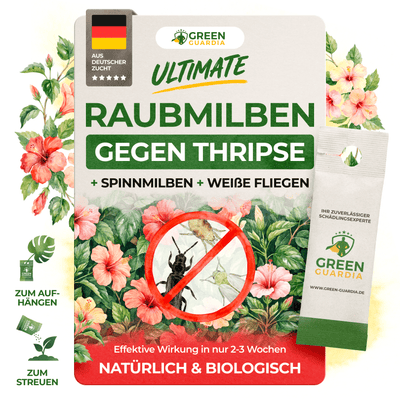
Cucumeris predatory mites for hanging or scattering
Our Cucumeris predatory mites (Neoseiulus cucumeris, also Amblyseius cucumeris) primarily prey on very young thrips larvae. They are particularly interesting when new larvae need to be caught early.
Advantages
- Targeted approach against early larval stages.
- Choose delivery form to suit the plant population.
- Can be used early and, depending on the product, preventatively as well.
Limitations
Adult thrips are not reliably caught. In case of a severe infestation, a supplementary measure may be necessary. Temperature and humidity must match the instructions.
Select Cucumeris variantSwirskii predatory mites against young thrips larvae
Our Swirskii predatory mites (Amblyseius swirskii) are warmth-loving beneficial insects. They prey on young thrips larvae and can additionally eat certain eggs and young stages of whiteflies.
Advantages
- For suitable warm crops.
- Available as a scatter or sachet variant.
- Can cover multiple pest groups when target stages are right.
Limitations
Warmth alone is not enough: Humidity and plant population influence success. Swirskii is not an automatic quick fix for many adult thrips.
View Swirskii predatory mitesOrius pirate bugs as a targeted addition
Our Orius pirate bugs (Orius laevigatus) prey on larvae and adult thrips. They thus extend control beyond very young larvae.
Advantages
- Larger spectrum of reachable thrips stages.
- Supplement in suitable plant populations.
- Nymphs and adult animals are predatory.
Limitations
Establishment requires suitable temperature, light, and food conditions. Adult animals can fly. For individual houseplants, suitability must be checked separately.
View Orius pirate bugsNematodes against thrips in the substrate
Our nematodes against thrips supplement control when suitable developmental stages are present in the substrate. A drench treatment targets areas where predatory mites on the leaves do not work.
Advantages
- Additional starting point in the development cycle.
- Application with water according to product instructions.
- Sensible supplement to treatment on the plant.
Limitations
Not every thrips species goes through its resting stages in the soil. A drench treatment does not cover the entire leaf infestation. Temperature and substrate moisture must be right.
View nematodes against thripsWhich beneficial insects against thrips should you order?
| Situation | Suitable consideration |
|---|---|
| Early infestation | Select Cucumeris or Swirskii based on conditions. |
| Suitable warm stock | Check Swirskii as an alternative. |
| Many adult thrips | Check Orius as a supplement, provided the crop is suitable. |
| Suitable stages in the substrate | Use nematodes as a supplement. |
| Severe, persistent infestation | Check pre-cleaning, application rate, and coordinated follow-up plan. |
Sachets or loose material?
Loose material allows direct distribution at suitable plant locations. Breeding sachets can continuously release predatory mites. Which variant fits depends on the delivery offer, plant distribution, and infestation progress.
How much should you order?
Orientate yourself by the current product instructions and coverage. Take plant area, foliage, and infestation strength into account. Separate pots are not automatically reached by roaming predatory mites. Plan suitable application points for the entire relevant stock.
Correctly releasing beneficial insects and monitoring success
- Confirm infestation: Check for live animals and typical features.
- Compare location conditions: Take temperature, humidity, and substrate conditions into account where applicable.
- Clarify previous products: Residues can harm beneficial insects. Compatibility and waiting time are product-specific.
- Use delivery promptly: Observe storage and shelf life according to instructions.
- Apply appropriately: Distribute loose material, hang sachets protected, or use the intended procedure for pirate bugs and nematodes.
- Protect beneficial insects: Do not rinse vigorously or spray untested products.
- Document progress: Regularly compare live thrips and new damage.
How fast do beneficial insects work against thrips?
Visible success depends on the initial infestation, beneficial insect quantity, and conditions. Protected eggs can hatch later while the beneficial insects regulate the population. A single observation directly after release is therefore not very meaningful.
Old damage remains visible
Silvery leaf spots will not become intact again. Even already damaged, still curled leaves can show further spots as they unfold. Therefore, assess success by live pests, new infestation spots, and further plant development.
If the infestation continues to increase
Check identification, application rate, release method, and location conditions. Look for overlooked neighboring plants. Repeats should be done according to product instructions and observed progress.
Preventing thrips and recognizing re-infestations early
- Thoroughly inspect new plants and initially observe them separately.
- Regularly check undersides of leaves, flowers, and new growth.
- Remove infested plant residues.
- Water plants according to their location and limit stress.
- Arrange plants so that inspections remain possible.
- Continue observing the stock after a treatment.
Preventative beneficial insect deployments should match the crop and product instructions. They do not provide unlimited protection against every later introduction.
Frequently asked questions about thrips and beneficial insects
Which beneficial insects help against thrips?
Predatory mites, pirate bugs, and suitable nematodes take on different tasks. Our product sections explain which option fits which situation. Reliable identification and suitable conditions are the foundation.
Should I order Cucumeris or Swirskii?
Compare the requirements with the climate of your plants. Both target mainly young larvae. Swirskii is warmth-loving. A heavier infestation alone does not dictate the choice.
Do I have to use Cucumeris and Swirskii together?
Not fundamentally. First, choose a suitable basis. A combination should be technically justified and tailored to the crop.
When are Orius pirate bugs useful?
When larger or adult thrips need to be targeted as well and the conditions suit the pirate bugs. Suitability must be checked separately for individual plants.
Are nematodes alone enough against thrips?
A drench treatment does not cover the entire infestation on the plant. It is a supplement if suitable substrate stages are actually present.
Do I need to replace the soil?
Not automatically. Whether the soil phase plays an important role depends on the thrips species. Replacing soil does not remove protected eggs from plant tissue.
Are blue sticky traps or rinsing enough?
Both can support, but do not reliably reach all developmental stages. Rinsing is best done before release. Sticky traps must be placed with flying beneficial insects in mind.
Can I use neem oil or soap solution additionally?
Only after checking specific compatibility. Such agents can also harm beneficial insects. A general combined application is not recommended.
Why do thrips come back despite treatment?
Hidden eggs, overlooked plants, or new immigration can play a role. Also check whether the beneficial insects had suitable conditions.
Can I save infested leaves?
Slightly damaged leaves can continue to contribute to nourishment. Old silvery spots remain, even if the infestation decreases. Do not remove leaves solely because of individual old spots.
How long do I need to keep monitoring?
Stick to the monitoring schedule of the chosen product. Continue to observe even after visible improvement to see if live thrips or new colonies appear.